How AI Could Turn the World Into Factorio
In Factorio, you don't build a factory by hand. You pick a blueprint, place it, and robots build it. One day we could build streets, farms and whole towns the same way.
· 7 min read
The game
Factorio is a game about building a factory. You land on a planet with nothing. You mine iron by hand. You build a furnace, then a drill, then a belt to connect them. Hours later you have a factory that makes rockets.
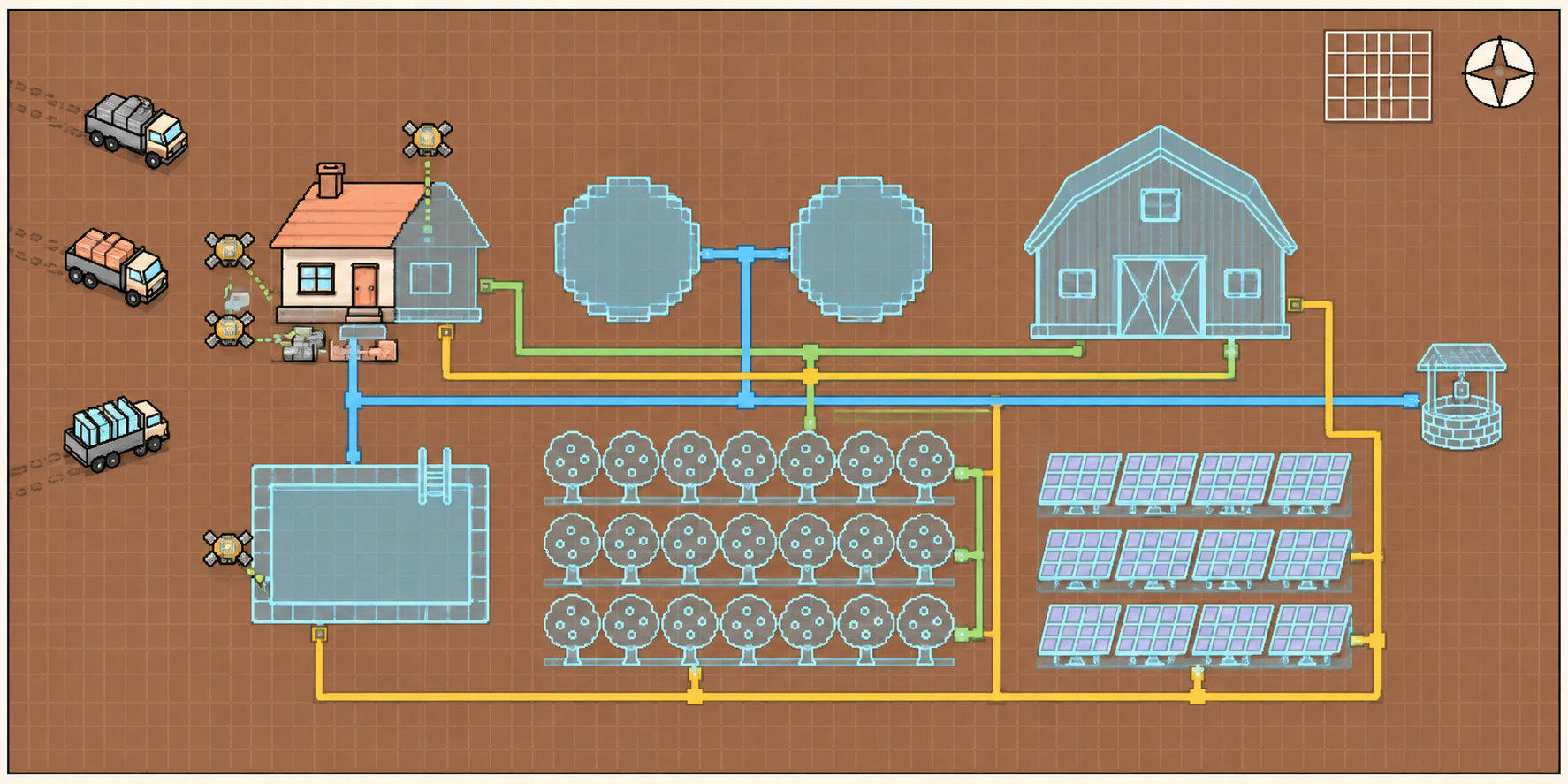
The part that matters here is how the late game works. You don't build by hand anymore. You design a piece of the factory once, a smelter line or a train station, and save it as a blueprint. Then you place the blueprint on the map. It shows up as a blue ghost. Construction robots fly out, bring the parts, and build it. A whole section of the factory goes up in a minute.
I keep thinking about that. What if the real world worked like that?
Where this starts
In How Artificial Intelligence Will Transform 100 Occupations, I split AI into three stages. AI that thinks. AI that works a computer on its own. AI that works in the physical world. In What Comes After AI Can Do Everything, I asked what people do once all three are done.
This post asks a narrower question. Once robots can do physical work well and cheap, what does building look like? My guess: it starts to look like Factorio.
Two examples
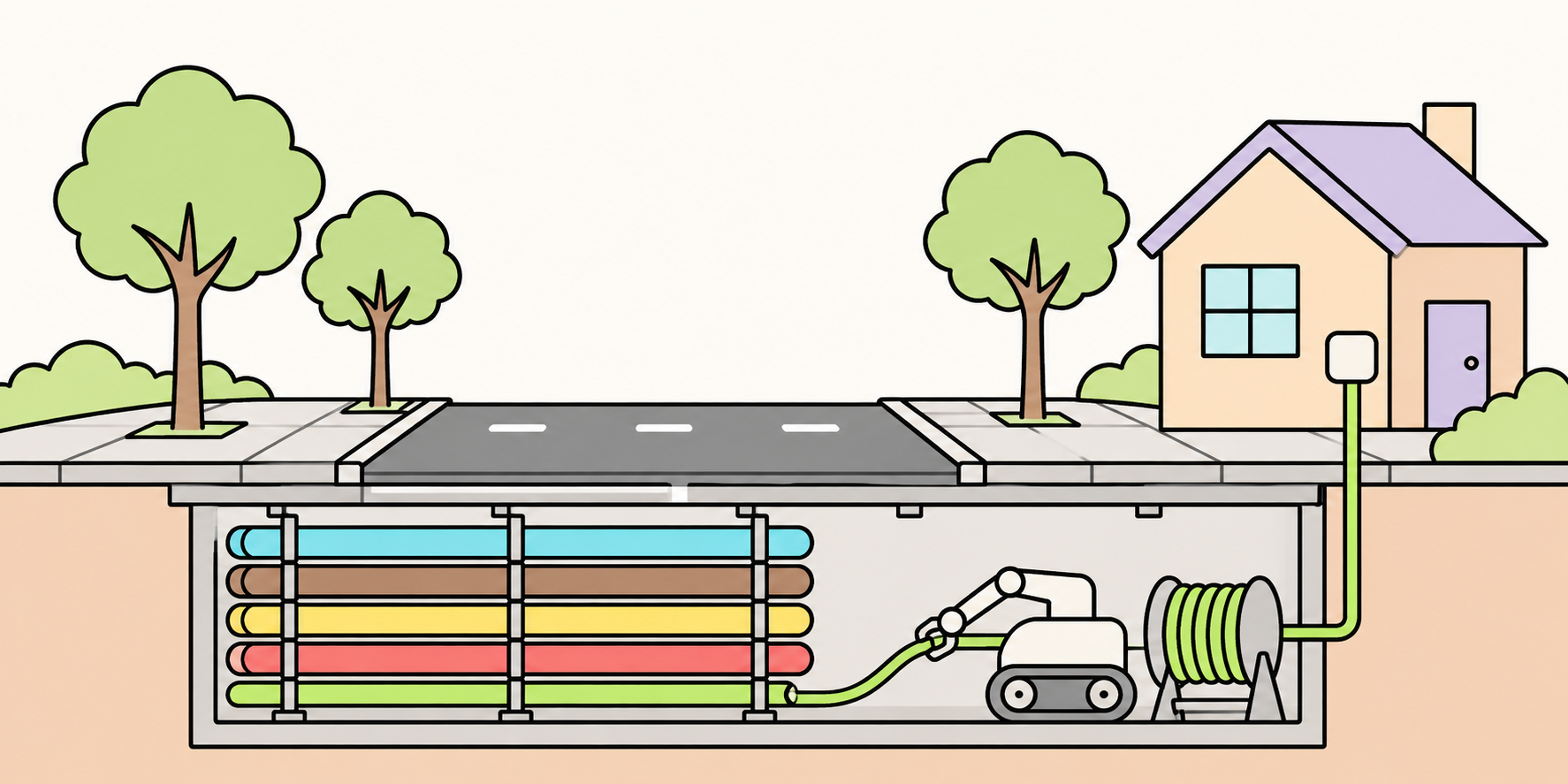
Fiber in one click. Today, if I want a direct fiber line from my home to a server downtown, it's weeks of calls, quotes and permits, and it costs a fortune. Now picture this. I click a button on a provider's site. Their system plans the route through standard channels under the streets. Robots pull the cable across the city that night. In the morning the link is up, and it cost about as much as a month of internet.
A farm in seven weeks. I buy an empty lot far from the city. I open a site with blueprints of farms, like a store of apps. I pick one: a house, two ponds, a pool, an orchard, a barn, solar power, a water well, plumbing and wiring all done. I place it on my lot, on a map, like in the game. I move the pond a bit to the left. I press build. Seven weeks later, the farm is there. The trees are planted, the water runs, the lights turn on.
What Factorio teaches
Factorio is a game, but it teaches real lessons about building. Five of them fit here.
Blueprints. Design once, build many times. If a blueprint has a flaw, you fix it once, and every new copy comes out fixed. Today every house is a small one-off project. Every builder solves the same problems again.
Standard interfaces. In the game, every belt fits every belt. Every pipe fits every pipe. A power pole connects to any other pole. That's why blueprints snap together. In the real world, a house could plug into the street the same way. One standard slot for water, sewage, power, heat and data. The house doesn't care who made the street.
Logistics networks. In the late game, you don't carry parts. You ask for them, and robots bring them from storage. A real version is a city where materials flow to each build site on their own, in the right amount, at the right time.
Throughput. Good players think in flows, not things. How much iron per minute. Where the line is blocked. A city is flows too: water, power, food, data, waste, people. Plan the flows first and the buildings follow.
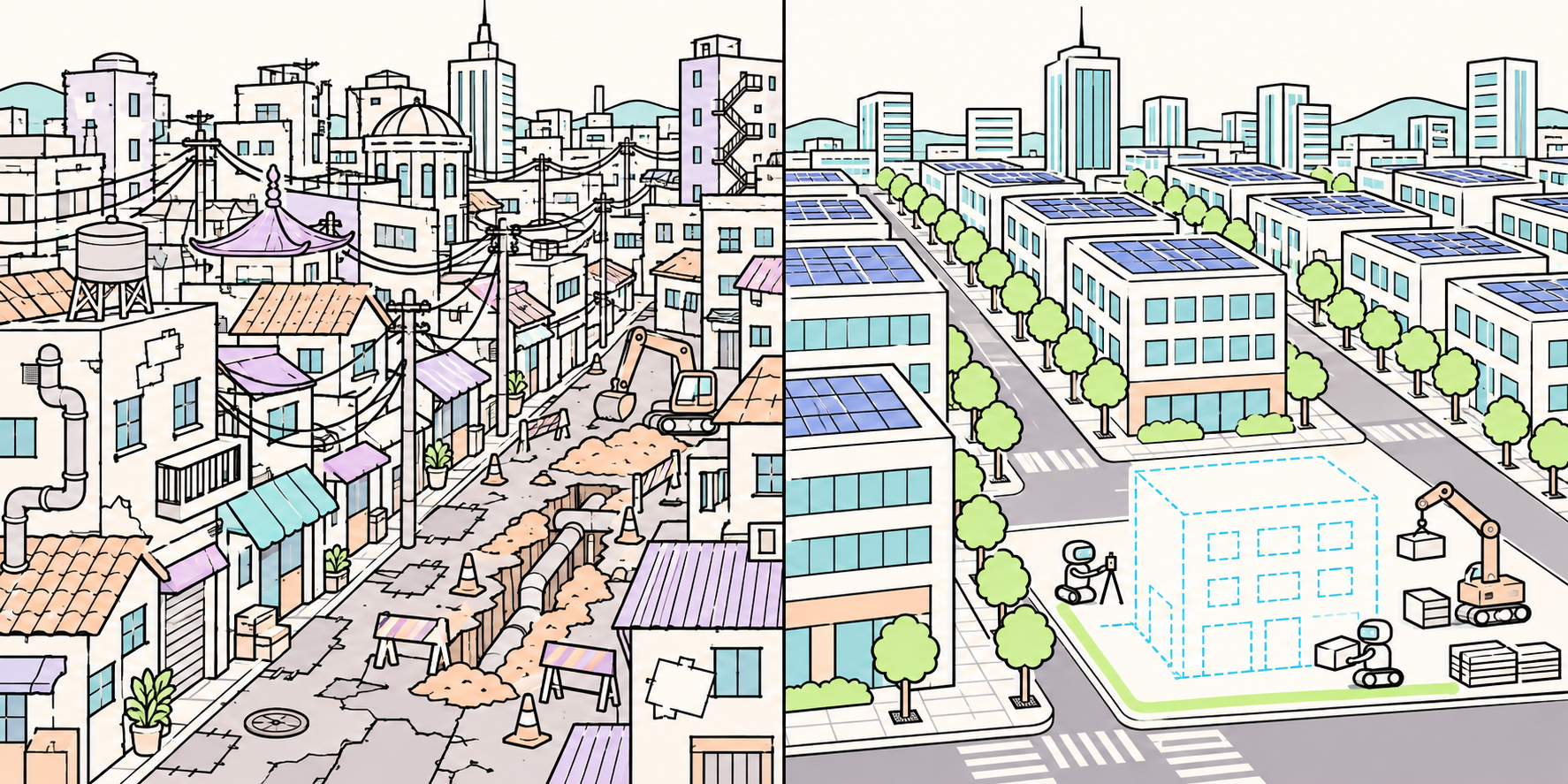
Refactoring the spaghetti. Every player's first base is a mess. Belts cross over belts. Nobody remembers why that pipe goes there. Players call it spaghetti. You don't fix spaghetti in place. You build a clean new base next to it, move production over, and tear the old one down.
Our world is a spaghetti base
Look at any city with Factorio eyes. Streets dug up three times a year, once for water, once for power, once for fiber. Wires hanging from poles. Pipes from different decades that nobody has a map of. Every building plugs into the city in its own way.
It works, more or less. But it's spaghetti.
Permits and paperworkDesign and quotesWaiting for trades and materialsBuilding
When we look at old civilizations, they look messy to us. Narrow streets, water carried by hand, waste thrown out the window. We understand them, though. A Roman could walk through a city today and still get the idea of a street, a house, a shop.
A blueprint world could open the same gap in front of us. We'd still see homes and streets. But how it all fits together, how it's planned, wired and kept up by machines, could be as hard for us to follow as a power grid would be for that Roman.
What has to be true first
None of this is close. A lot has to happen first.
- Robots that build. This is stage three, and it's the hard one. Building sites are messy, muddy and never the same twice. And the robots must be cheap, which in the end means robots building robots.
- Standards. This might be harder than the robots. Every house, street and pipe has to agree on how they connect. That's not a tech problem. It's people and countries agreeing.
- Law. Today a project is approved one by one. A blueprint world needs blueprints approved once, like a car model is approved once and then sold a million times. Then placing one on a lot is a check, not a year of paperwork.
- Energy. Everything in Factorio runs on power. So would this. Robots, factories and transport all need a lot of cheap, clean energy.
- Materials. Fast building needs fast supply. Concrete, steel, pipes and cable have to flow like on the belts in the game.
- Real ground. A real lot is not a flat grid. It has slopes, rock, rivers and old pipes nobody mapped. Blueprints have to bend to the land, not the other way around. Even in Factorio you clear trees and walk around cliffs.
What could go wrong
Every place looks the same. Factorio bases all start to look alike, because the best design wins. A world of blueprints could be a world of copies. I think the fix is the same as in software: standard parts underneath, endless variety on top. The plug in the wall is the same; the house is yours. But it's a real risk.
Who designs the blueprints. If a few companies own the blueprints, they own how we live. I'd like open blueprints, shared and improved by anyone, like open-source code.
Who owns the network. In the fiber example, whose cable is it? If my house only works with one company's modules, I'm locked in. Standards only help if nobody owns them.
One bug, ten thousand homes. A flaw in one blueprint gets copied everywhere it was placed. In software, we fix it with an update. In concrete, it's harder. Blueprints would need testing as strict as planes get.
Nature. Factorio has a lesson here too. Your factory pollutes, and the planet fights back. Build fast and you can also destroy fast. A machine that builds a farm in seven weeks can flatten a forest in one.
Old places. What happens to the spaghetti we already have? Old towns have history and soul. Maybe we keep them, the way we keep old city centers now. Maybe the clean world grows next to the old one, like a new base.
Open questions
- Who pays? Building gets cheap, but land doesn't.
- Moving around. If a farm takes seven weeks, do people move more? Pick a place for a few years, then build the next one?
- Taking things apart. In Factorio, robots also deconstruct and get the parts back.
- Cities as code. If a city is a set of blueprints, it can have versions, reviews and updates, like software.
- Who places the blueprint? Me on my lot, sure. But a whole neighborhood?
The factory must grow
Factorio players have a joke: "the factory must grow". The game never ends. You can always make it bigger and cleaner.
The real world won't be that simple. Land, people and nature are not a game map. But I think the core idea holds. Most of the mess around us is not because we don't know better. It's because building is slow, expensive and done by hand, one project at a time. When that stops being true, the mess doesn't have to stay.
Illustrations generated with AI.